

Best Travel Cameras: Tested by a Pro Photographer (2026)


After 20+ years shooting travel photography professionally, here are the travel cameras I’d actually buy — ranked by category, tested in the real world, for every budget.
Every year I get emails from readers asking the same question: what camera should I buy for travel?
My answer is that it depends entirely on you. What matters most to you — size? Image quality? Video? Budget? The camera that’s right for a backpacker who wants something pocketable is completely different from what’s right for someone who wants to print large-format photos of their trips.
When readers and members of our Instagram community ask what camera I personally use, I always say the same thing: what works for me won’t necessarily work for you. But what I can do is tell you exactly which cameras are worth your money right now, and why — based on real-world use, not spec sheets.
In addition to this post, I recommend also reading our guides to the best compact camera, the best camera lenses, and the best cameras for hiking and backpacking.

Quick Recommendations
Here’s a quick look at my top picks for 2026 — keep reading for full reviews of each one.
- Best Overall Travel Camera: Fujifilm X-E5 — incredible image quality in a compact, discreet body that doesn’t scream “expensive camera”
- Best Compact Travel Camera: Fujifilm X100VI — fixed-lens perfection for travelers who want one camera that does everything
- Best Full-Frame Mirrorless for Travel: Sony A7C II — full-frame quality in a remarkably small body
- Best Weather-Sealed Travel Camera: OM System OM-3 — rugged, weather-sealed, and shockingly compact thanks to the Micro Four Thirds system
- Best Budget Mirrorless: Canon EOS R50 — under $800 with a kit lens, beginner-friendly, and genuinely good
- Best Underwater/Action Camera: GoPro Hero 13 Black — still the gold standard for adventure and water photography
- Best Smartphone for Travel Photography: iPhone 16 Pro — for when you don’t want to carry a camera at all
Table of Contents
Best Cameras For Travel
There are several types of travel cameras on the market — fixed-lens compacts, mirrorless, action cameras, and smartphones — and each one has its own set of tradeoffs.
First and most importantly, think about what matters most to you: size, weight, image quality, budget, or ease of use. Below I’ve broken down the best options in each category, along with their pros and cons, so you can find the right fit for how you actually travel.
Which Type of Camera is Best for Travel Photography?
Are mirrorless cameras better for travel? This really depends on your preference, but working as a professional travel photographer for the past 20 years, I’ve personally found mirrorless cameras give me the most versatility — specifically, the Sony A7 IV.
If you want to get a more compact version of the Sony camera I have, get the Sony A7C II. I personally use my camera for portrait photography as well and wanted the dual card slots, better viewfinder, and better handling with big lenses that the A7 IV provides.
One thing I want to stress is when it comes to travel photography, get something you know you won’t regret carrying around. Otherwise, you may find yourself leaving the camera in your hotel room and just shooting with your phone.
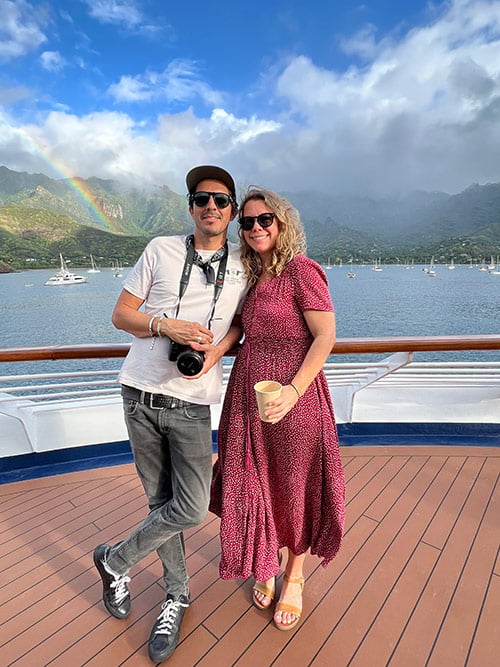
Here’s how I think about it now:
If you want the best image quality in the smallest possible body: A fixed-lens compact like the Fujifilm X100VI is genuinely impressive — and means one less decision every time you leave the hotel room.
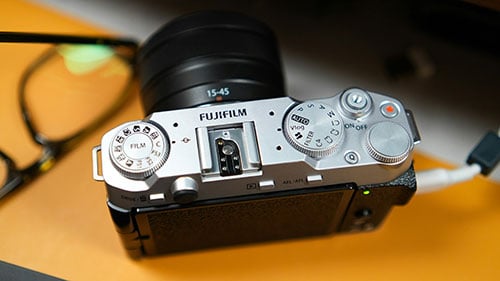
If you want flexibility to grow your gear over time: A mirrorless system like Fujifilm’s X-series, Sony E-mount, or OM System is the way to go. The APS-C options are especially good value for travel because the lenses stay small and light.
If you want the absolute best image quality: Full-frame mirrorless like the Sony A7C II delivers extraordinary results, and the body is much smaller than people expect.
If you’re just starting out and aren’t sure: Start with something like the Canon EOS R50. It’s affordable, small, takes genuinely great photos, and if you end up loving photography, you can grow into a more advanced system without regretting your first purchase.
I no longer carry a DSLR at all. I spent years shooting with Canon 5D Mark II and III bodies, but mirrorless has simply gotten too good.
You can find my full gear list here: The Ultimate Packing Guide for Travel Photographers
Best Compact & Fixed-Lens Cameras
If your main concern is size and weight, a compact or fixed-lens camera is the way to go. These cameras won’t weigh down your bag, they’re discreet enough that you won’t attract attention in crowded markets or temples, and the best ones in 2026 produce image quality that would have seemed impossible from a pocketable camera just a few years ago.
The tradeoff is that most of these cameras have a fixed lens — meaning you can’t swap it out for a different focal length. For a lot of travelers that turns out to be a feature rather than a limitation. You stop fussing with gear decisions and start paying attention to what’s in front of you.
Fujifilm X100VI
Fujifilm X100VI – Check Prices Here
Details: 40.2MP APS-C X-Trans sensor, fixed 23mm f/2 lens (35mm equiv), 5-axis IBIS, 521g
If you want one camera to take everywhere and you’re comfortable with a fixed focal length, the X100VI is the most complete camera on this list. The 40MP sensor is genuinely stunning — sharp enough for large prints, with Fujifilm’s gorgeous film simulations built in. It also has in-body image stabilization now, which the previous version didn’t, making it much more useful in low light.
The 35mm equivalent focal length is incredibly versatile — landscapes, portraits, street photography, interiors — all work well with it.
Fair warning: these cameras have been selling out consistently since they launched. If you’re considering one, buy when you see them in stock.
Pros: 40MP APS-C sensor, beautiful Fujifilm color science and film simulations, IBIS, excellent build quality. Cons: Fixed focal length; pricier than it used to be; supply can be limited.
Sony RX100 VII
Sony RX100 VII – Check Prices Here

Details: 20.1MP 1-inch stacked CMOS sensor, Zeiss Vario-Sonnar 24-200mm lens, continuous shooting up to 20fps, 4K video.
The RX100 VII remains a genuine option if you want a 1-inch sensor camera with a zoom range — it covers 24-200mm in a pocketable body, which is hard to beat for versatility. That said, the APS-C options above now offer meaningfully better image quality at similar price points, so if you don’t need the zoom range I’d lean toward one of those. Where the RX100 VII still wins is the combination of zoom + pocketability.
Pros: Excellent zoom range in a compact body, fast autofocus, great for action and wildlife subjects. Cons: Smaller 1-inch sensor vs APS-C alternatives; expensive for what it is in 2026.

Best Mirrorless Cameras For Travel
If image quality, flexibility, and the ability to grow your kit over time are what matter most to you, mirrorless is where you want to be. Unlike fixed-lens compacts, mirrorless cameras accept interchangeable lenses — so you can start with a versatile zoom and add a portrait lens or a long telephoto later as your photography evolves.
The mirrorless market has matured enormously in the last few years, which means there are now genuinely great options at every price point. Here are the ones I’d recommend in 2026.

Fujifilm X-E5 — Best Overall
Fujifilm X-E5 – Check Prices Here
Details: 40.2MP APS-C sensor, 5-axis IBIS, 337g body, USB-C charging
This is the camera I’d buy if I were starting fresh today. The X-E5 has the same stunning 40MP sensor as the X100VI but in a rangefinder-style body that accepts Fujifilm’s excellent range of interchangeable lenses. Paired with one of their compact f/2 primes — the 23mm or 35mm are my favorites — the whole kit is remarkably small and light for the image quality you’re getting.
What I love about shooting Fujifilm for travel is the film simulations. You can dial in a look you love and share gorgeous JPEGs straight from the camera without sitting at a laptop editing every frame. When you’re moving fast between destinations, that matters.
Pros: Outstanding 40MP image quality, lightweight system, beautiful color and film simulations, excellent build quality. Cons: Not weather-sealed on the body itself; APS-C rather than full-frame.
Sony A7C II — Best Full-Frame
Sony A7C II – Check Prices Here
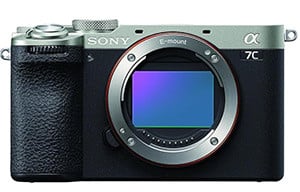
Details: 33MP full-frame sensor, 5-axis IBIS, AI autofocus, flip-out touchscreen, 514g
If you want full-frame image quality — the kind that holds up at large print sizes and performs beautifully in low light — but don’t want to carry a full-frame-sized camera, the A7C II is genuinely remarkable. It’s one of the smallest full-frame mirrorless bodies available, and Sony’s E-mount ecosystem gives you access to an enormous range of lenses.
The autofocus system is exceptional. Subject tracking for people, animals, and moving objects is class-leading, which makes a real difference when you’re photographing street scenes or wildlife.
Pros: Full-frame image quality, compact for a full-frame camera, outstanding autofocus, excellent low-light performance. Cons: Full-frame lenses are larger and more expensive than APS-C equivalents; pricier than the other options here.
OM System OM-3 — Best for Adventure & Outdoor Travel
OM System OM-3 – Check Prices Here
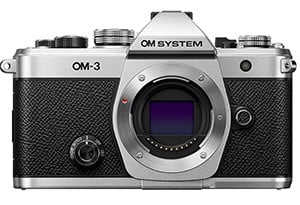
Details: 20MP Micro Four Thirds stacked sensor, IP53 weather sealing, 5-axis IBIS, 50fps burst, 414g
If you travel somewhere weather is unpredictable — or you’re hiking, doing safari, or anywhere near water — the OM-3 deserves a serious look. The IP53 rating means it’s genuinely weather and splash-proof, not just “weather resistant” in fine print. And because it’s Micro Four Thirds, the lenses stay impressively small and light — a real advantage when you’re already carrying a full pack.
The 50fps burst and subject-tracking autofocus also make it one of the better options for wildlife photography among travel cameras at this price point.
Pros: Robust weather sealing, compact lens system, fast burst shooting, great value for what you get. Cons: Micro Four Thirds sensor shows more noise than APS-C or full-frame at very high ISO settings.
Canon EOS R50 — Best for Beginners
Canon EOS R50 – Check Prices Here
Details: 24.2MP APS-C sensor, Dual Pixel autofocus, 4K video, flip-out touchscreen, under $800 with kit lens
This is what I’d hand to someone who is just getting into photography and wants a capable travel camera without spending a fortune or feeling overwhelmed. Canon’s color science means your photos look great even in auto mode, and the Dual Pixel autofocus is smart enough to keep up with most travel situations without you having to think about it.
The flip-out screen is more useful than it sounds — shooting from low angles, overhead crowds, or for video becomes so much easier. And 4K video means it doubles nicely as a travel vlog camera.
Pros: Affordable, excellent image quality for the price, beginner-friendly, reliable autofocus, good video quality. Cons: No in-body stabilization; single card slot; smaller lens ecosystem than Sony or Fujifilm.
Best Travel Camera Under $500
The truth about this budget in 2026 is that the new camera market under $500 is pretty thin. Smartphone cameras have pushed most entry-level point-and-shoots out of existence, and the good mirrorless options start above that price point new.
The best move at this budget is the used and refurbished market, which has never been better. Sites like MPB and KEH Camera grade used gear carefully and back it with warranties — I’ve bought from both and had great experiences.
Best under $500 strategy: Look for a used Fujifilm X-T30 II or a refurbished Canon EOS R50. Both regularly appear in the $400–500 range in excellent condition, and either one will massively outperform anything you’d find new at that price.
If you need something new and under $500, the Panasonic LUMIX FZ80 is the one I’d point you toward — particularly if zoom range matters to you.
Panasonic LUMIX FZ80 4K
Panasonic LUMIX FZ80 – Check Prices Here
Details: 18.1MP sensor, 60x optical zoom (20–1200mm equivalent), 4K video, built-in WiFi, lightweight body
The 60x optical zoom is genuinely extraordinary for the price — nothing else comes close at this budget for reach. For daytime outdoor photography, wildlife at a distance, or travel situations where you want one camera that covers wide to super-telephoto, it does the job. Just know that the smaller sensor shows its limitations in low light or when you’re printing large.
Pros: Incredible zoom range, lightweight, affordable, 4K video. Cons: Smaller sensor limits low-light and print quality compared to APS-C options.
Best Underwater & Action Camera For Travel
No travel camera guide is complete without talking about water. Whether you’re snorkeling in Thailand, kayaking in Croatia, or just want something you can hand to a kid at a waterpark without anxiety, this category has a clear winner.

GoPro Hero 13 Black
GoPro Hero 13 Black – Check Prices Here
Details: 5.3K video, HyperSmooth 6.0 stabilization, waterproof to 33ft without a housing, 10-bit color, 154g
The Hero 13 Black is the best GoPro they’ve ever made and it’s become a permanent part of my travel kit. The HyperSmooth stabilization is the thing that changed everything for me — handheld and activity footage actually looks smooth and watchable instead of shaky and nauseating. Earlier GoPro versions I could take or leave; this one I genuinely reach for.
The fact that it’s waterproof to 33 feet without any additional housing means one less thing to remember to pack and assemble before you jump in. I’ve also started using it on land more than I expected — mounted to a bag for walking footage, or as a wide-angle option when I don’t want to pull out a bigger camera.
Pros: Best-in-class video stabilization, waterproof without a case, lightweight, versatile mounting system. Cons: Not a substitute for a dedicated camera for still photography.
Best Smartphones For Travel Photography
I want to be upfront: the gap between a flagship smartphone and a dedicated compact camera has narrowed significantly. If you travel light and shoot primarily for social media, today’s best phones are genuinely impressive. Where a dedicated camera still wins is in tricky light, when you want real control over your settings, or when you’re printing larger than phone screens.
With that said, here are the best options right now.
iPhone 16 Pro — Best overall
iPhone 16 Pro – Check Prices Here
Details: 48MP main + 48MP ultrawide + 5x optical zoom, 4K ProRes video, ProRAW support
The 5x optical zoom is what makes this genuinely useful for travel photography — you can photograph a detail on a building across a square, or pull in a market scene without pushing through the crowd. ProRAW support means you can capture and edit files like a proper camera if you want to. And the 4K ProRes video is remarkable quality from something that fits in your pocket.
Pros: Best-in-class smartphone camera, 5x optical zoom, ProRAW, excellent video. Cons: Expensive; still can’t match a dedicated camera in very low light.
Google Pixel 9 Pro — Best computational photography
Google Pixel 9 Pro – Check Prices Here
Details: 50MP main + 48MP ultrawide + 5x optical zoom, Night Sight, Magic Eraser
Google’s computational photography has always been in a class of its own and the Pixel 9 Pro continues that. Night Sight in very low light is genuinely impressive, and features like Magic Eraser — which removes unwanted people or objects from your shots — are the kind of thing you start relying on heavily once you have them. Images tend to look more natural straight out of the camera compared to iPhone’s more polished, saturated look.
Pros: Outstanding low-light performance, excellent computational features, natural color rendering. Cons: Video not quite as strong as iPhone in our experience.
Samsung Galaxy S25 Ultra — Best zoom range
Samsung Galaxy S25 Ultra – Check Prices Here
Details: 200MP main camera, 10x optical zoom, 8K video
If zoom range is your priority in a smartphone, nothing else comes close. The 10x optical zoom — 200mm equivalent — means you can genuinely reach subjects at a distance in a way no other phone can match. The 200MP sensor also gives you real flexibility to crop into a shot without losing detail. Just know that Samsung’s processing tends to be heavy-handed — images can look over-sharpened if you’re not careful with the settings.
Pros: Best optical zoom in any smartphone, enormous resolution, highly versatile. Cons: Very expensive; aggressive default processing can make images look artificial.
How To Choose a Travel Camera: Travel Camera Buying Guide
Sensor Size
When it comes to sensor, the larger the size the more light it can capture. Sensor size is especially important when considering whether you’ll be taking a lot of low light shots, as if it has a small sensor size you’ll generally get a grainy photo.
For example, smart phones usually have a very small sensor size, and thus tend to not take awesome low-light pictures. Sensor sizes tend to increase as the size of the camera does, and in the DSLR realm, the sensitivity is measured as ISO.
Aperture
The aperture controls the brightness of an image, and the number that correlates to it refers to the size of the hole that lets light into the sensor. Apertures are shows as f-numbers (for example, f/2.8, f/4, etc.), and the larger the number, the smaller the hole.
Generally speaking, if you’ll be shooting in low-light, look for smaller numbers, as these will let more light into the sensor.

Megapixels
The megapixel number on your camera refers to the size of image the camera can produce. One megapixel means one million pixels, and as the number goes higher you’ll get clearer resolution in your photos. This is especially important if you plan on making prints.
While megapixels are important, if you truly want excellent-quality photos then be sure to take into account sensor size and aperture as well.
Optical & Digital Zoom
With point and shoot cameras, zooming in on faraway objects with your optical zoom essentially allows you to magnify the image and make the objects in the frame appear closer without reducing quality. So, if you have 8x optical zoom option, that means you can make object appear 8x larger in the frame.
Digital zoom, on the other hand, is when your camera zooms in on a frame and crops what isn’t shown on your screen. This only reduces the quality of the image, so steer clear.
Focal Length
When picking out a lens for your DSLR, focal length refers to optical zoom, and is the distance between the sensor and the lens when the subject is in focus. Measured in millimeters, a lower focal length means the lens can be used for wider shots.
EIS/OIS
EIS (Electronic Image Stabilization) and OIS (Optical Image Stabilization) are image stabilizers that correct small movements when taking a photo and eliminate blur. OIS is great for improving low light photography, while EIS is primarily a video stabilizer.
Read more: What 20 Years As A Travel Photographer Has Taught Me
What to Look for When Buying a Travel Camera
Ergonomics & Navigability
Before you purchase, think about your travel habits and what features will suit your needs. Do you need a small, light camera for easy shots, or are you looking for a more professional DSLR? Comfort, size, and weight of the camera will all factor into this. Also consider if the camera is easily navigable, and if it has easy accessibility to common functions.
WiFi
What about your WiFi needs? If you’re someone who likes to import straight to your smartphone or computer after you’ve taken a shot, then purchasing a camera with WiFi capabilities will be handy.
Lens Selection
Also consider the lens selection that your camera can support, as you won’t be able to swap out different brands lenses due to the unique mounts. Most of the main lines will have many of the same lens options, but it’s something to look into if you have specific requirements.
Video
Almost all cameras on the market today shoot video, but there are certain aspects to pay attention to depending on what quality you’d like to achieve. Frame rate is the most important, with 24 – 30 frames per second being in a normal range, while up to 60fps will give you smoother playback.
FAQ: Buying a Travel Camera
In 2026, mirrorless has genuinely replaced DSLRs as the default recommendation for most travel photographers. They’re smaller, lighter, have excellent autofocus systems, and the lens ecosystems have matured to the point where there’s no meaningful gap. If you’re buying new, go mirrorless. If you already own a DSLR you love and it works for you, there’s no urgent need to switch.
My recommendation for beginners in 2026 is the Canon EOS R50 or a used Fujifilm X-T30 II. Both give you a real APS-C sensor, room to grow as you learn, and won’t break the bank. If you want something even simpler with no lens decisions, the Fujifilm X100VI (if budget allows) or Ricoh GR IV are wonderful fixed-lens options.
No. For travel specifically, I’d argue a full-frame camera is often overkill. APS-C mirrorless cameras like the Fujifilm X-E5 produce extraordinary image quality, and the smaller sensor size means smaller, lighter lenses. Unless you’re printing very large or shooting professionally in very low light, APS-C will serve you beautifully. That said, if image quality is your top priority and weight isn’t a concern, something like the Sony A7C II is a joy to shoot with.
The Fujifilm X100VI or Ricoh GR IV — both are fixed-lens cameras you can slip into a bag pocket, and both produce images that will genuinely impress you. No lens swapping, no decisions, just pick it up and shoot. The X100VI is the more versatile of the two; the GR IV is smaller and more pocketable.
More Travel Photography Resources:
How to Take Amazing Photos as a Solo Traveler
Best Compact Camera: The Complete Buying Guide
The Best Camera Lenses for Travel Photography
The Best Carry-On Luggage (For Every Type of Traveler)
Sony a7II: Why I Love This Camera for Travel Photography
The Best Cameras for Hiking & Backpacking
Pin it!

As an Amazon Associate I earn from qualifying purchases. I’m also a member of other affiliate programs. For more info please read my Privacy Policy
This is such an informative post, Christy and Scott! I am in the market for a new camera as my old one broke. Well, it really is not as modern and we have used it for years; guess it just really is time to let it go and buy a new one. Thanks for sharing, we’d definitely be looking into these cameras.
So happy to hear the post was helpful! Congrats on your new camera purchase. 🙂 It’s so fun getting new equipment!
Hello,
Thank you very much for this post; I found it helpful. Can you recommend a camera for me? I was thinking of finally upgrading my cell phone so that I would have a better camera on hand but I am not pleased with the clarity once I zoom in on many cell phone pics. I am looking for a travel camera that takes great nature photos (I love to photograph flowers, trees, nature walks, insects, kayaking, etc) but will also need to take pictures of active children and animals (limited lag) in all light settings. I do not plan to purchase a camera in which I would interchange lenses. Preferably a lightweight camera that I can carry in my purse. Preferably no more than the $400-$500 range but I am open to something that works best for my needs listed above. I greatly appreciate your input.
How about Nikkon DS5300? is it good for travel and selfie?
That is a decent camera!
Thank you!
Absolutely love this post! Thank you. I’ve spent the last few weeks drowning in information and agonising over which camera will be the best for me. As a complete beginner who wants to capture great images but wouldn’t have the slightest idea where to start with changeable lens this guide is ideal. I think I’ve decided on a bridge camera – the Canon PowerShot SX60 which I think is similar to the SX720 you’ve mentioned in this article!
That’s so great to hear! What made you choose the SX60 over the 720?
Mainly recommendation, I know quite a few people who have (or have had) the SX60 and they basically said that for the extra £70-100 it was worth it. I want it mainly for a safari I have planned later this year too so I think the better zoom on the SX60 may come in handy!
oh! after 3 hours wasting I have found some best travel camera review. I will buy Sony A7 ii . What is your recommendation about that?
I love the Sony A7ii! I upgraded from my Canon 5D Mark II last year and wrote a full review here: http://ordinarytraveler.com/articles/sony-a7ii-mirrorless-camera
This is a great post! But you should include also smartphones. They are great for travel.